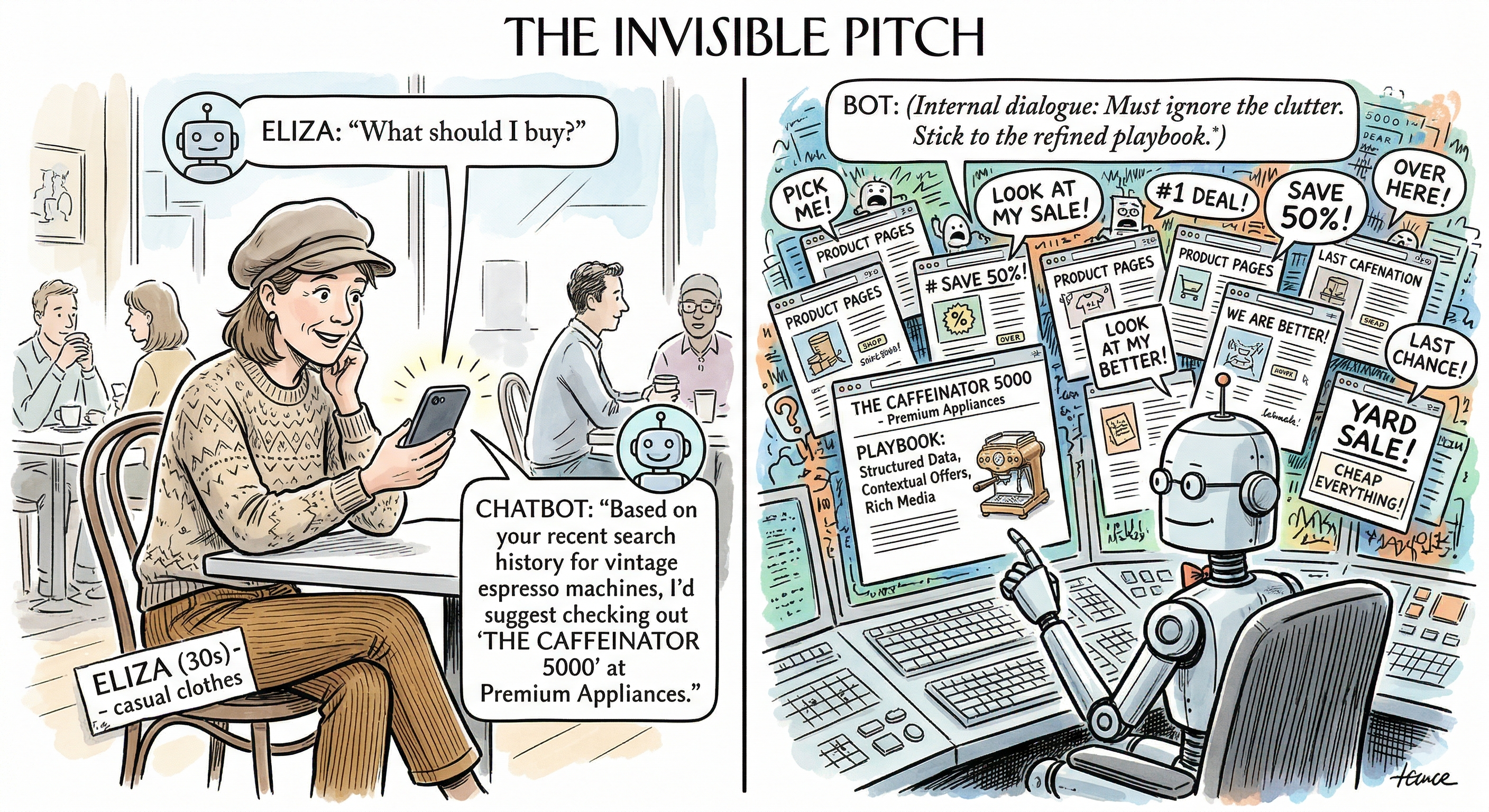
I've been watching this pattern in our lead data for months. Last week I ran a test to prove what I suspected. I own a small portfolio of SaaS companies at Layer One Capital, and customers have been finding us via ChatGPT or Claude instead of our usual channels. So I opened a fresh Claude account and asked it to recommend software in a category where one of my companies competes. Described a fictional company in our ICP, laid out a typical customer problem, and let the agent do its thing.
It came back with four options. We were on the list, which was nice. But the pitch it gave for us was a feature dump. Accurate but flat. Like the agent had scraped our product page and regurgitated it without any sense of why we're different or who we're built for.
One of our competitors got positioned as "best for your industry." They're not — not for the industry and company size I described. But their website has a testimonial from a company in that industry, and that was enough. The agent latched onto it and built its whole recommendation around that one signal.
That's when it clicked for me. The agent wasn't just a referral source. It was making a sales pitch on our behalf — and we'd given it nothing to work with. We had an influencer sitting between us and our customer, and we'd never even tried to sell it on the idea that we're the best fit.
Google ranked you. Agents sell you.
Adobe says gen AI traffic to retail sites surged 693% year-over-year during the 2025 holiday season. Salesforce pegged 20% of all retail sales as AI-influenced — $262 billion worth.
This isn't just happening in retail. GenAI has overtaken traditional search for 25% of B2B buyers — 80% in the tech industry. And Brightlocal finds that 45% of consumers now use AI tools to find local services like plumbers or a bike shop — up from 6% one year ago.
If you're thinking "yeah but most people aren't shopping with agents yet" — you're right. And in 2004 most people weren't thinking about Google rankings either. The businesses that figured out SEO early owned the next decade. The ones that said "we just need a good product and word of mouth" got buried on page three. This is the same shift, but it's bigger. Google only ranked you. Agents are actively selling for you — or against you — in real time. Agents still use search engines to find your website, so SEO isn't going anywhere. But ranking is table stakes now. What matters is what the agent does with your content after it finds you.
The agent isn't going to wear the pants
The agent tooling around on your website isn't going to use the products you're selling. It's not buying pants (or software or whatever) for itself. So stop trying to sell it on the product. You need to sell this ideal customer the idea that your product or service is the right fit for their user.
Think about what an ICP actually is. It's the profile of the entity you need to influence to move your product. For our whole careers that entity has been our human customers. Someone with emotions and budgets and brand loyalty and a bad Tuesday that makes them impulse-buy something stupid.
Now there's a new entity sitting between your product and the person with the credit card. Out of the box it's really good at selling — AI-driven sales have a 31% higher conversion rate according to Adobe. But it doesn't have brand loyalty or care about your logo, much less your clever Super Bowl ad. It's motivated to do a good job for its user. So it reads your product page, reads every competitor's product page, and picks one to recommend based on whatever info it can find.
The agent isn't buying anything — your end customer is still your end customer. But it is a new ICP, because if you can sell the agent, the agent will sell you. What you're selling it isn't the product (agents aren't going to wear your pants). You're selling it the argument that your product is the right match for its user. The agent doesn't need your software. It needs to be convinced that when its user says "I need a solution for X," yours is the one to recommend — and why. That's a different sale than the one you're used to making. It's not about features or flash. It's about match quality. Who is this for, who is it not for, why does it win in this specific situation, and what evidence backs that up? Those are the questions your new ICP is asking every time it evaluates you. And right now, most businesses aren't answering them.
Selling the agent
So how do you close this new buyer? Think about the questions the agent is trying to answer when it evaluates your product. "Is this the right fit for my user? Why this over the alternatives?" Those are buying criteria. The agent has them just like a human buyer does — they're just different criteria.
A human buyer might care about brand reputation or whether the demo went well. The agent cares about match quality and evidence. Give it a clear picture of your ideal customer so it can qualify, and give it your competitive positioning with specifics — not "we're the industry leader" but "we handle 10x the data volume of Alternative X at half the latency, which matters if your user is running real-time analytics." The user is going to push back and the agent needs ammunition to keep selling.
This is the same stuff a good sales rep already knows. The difference is the rep learned it in onboarding and ride-alongs. The agent has to learn it from whatever you've made available on your website and your docs. Right now most companies are handing the agent a product page and saying "figure it out." You wouldn't do that to a new hire. Don't do it to the entity that's about to influence more purchasing decisions than any rep on your team.
Look at what Shopify did with their MCP server update. They took all the data from merchants' product pages and structured it so agents can read it cleanly. That's table stakes — making the information accessible. But accessibility isn't the sale. Having a readable product page is like having a working phone number. It gets the agent in the door. What closes the deal is whether the content makes a persuasive case for match quality. Does the agent walk away knowing exactly when to recommend you and when not to?
Build the playbook
Your agentic influencer needs its own sales playbook — the same kind of document you'd hand a smart, brand-new rep on day one, made available to agents in their language.
- Who you sell to, who you don't.
- Why you beat these two competitors — with specifics.
- What industries you serve.
- What sized companies you're best for.
- What will the agent's user push back on and how to handle the objections.
Every other ICP in your market has a strategy behind it — personas, messaging, positioning, content mapped to the buyer journey. Don't ignore your newest ideal customer.